Who's the Best for Cloud PACS: Sectra vs Medicai
Most radiology teams pick a cloud PACS after they hit storage limits or watch image-transfer tickets pile up in another system. That choice now sits between Sectra and Medicai, and the gap shows up in daily workflow hours rather than marketing slides.
By the end of this article you will see the storage and sharing differences that matter for multi-site reading rooms, the security rules that affect each vendor choice, and the pricing model each platform uses, so you can decide which fits your case mix without another round of vendor demos.
Quick Verdict: Medicai Edges Sectra for Most Cloud PACS Needs
Medicai provides faster deployment, lower upfront costs, and native zero-footprint viewing capabilities that appeal to most radiology practices seeking cloud-based imaging infrastructure.
The comparison between these two Cloud PACS platforms reveals distinct differences in how each serves growing radiology practices. Deployment time stands out as one of the most practical differentiators when clinics need to get systems running quickly.
Traditional PACS vendor solutions often require weeks of setup, configuration, and training before teams can access imaging tools. Cloud-native platforms compress this timeline to days, reducing the disruption that comes with switching vendors or expanding services.
Cost structures also influence the decision. Subscription pricing starting at $249 per month removes the large capital outlay associated with traditional licensing models. This approach lets smaller practices and growing networks access enterprise-grade tools without extended procurement cycles.
Uptime SLA commitments matter when patient care depends on constant access to imaging studies. A 99.9 percent guarantee across a global cloud infrastructure means fewer interruptions and more reliable service for multi-site operations.
AI partnerships for image enhancement represent another practical advantage. Integrated tools can improve study quality and support faster interpretation without requiring additional software or separate vendor contracts.
HIPAA and GDPR compliance with a zero-footprint DICOM viewer addresses both security requirements and access needs. Clinicians can review studies from any location without installing software or managing local installations.
At a glance: how Medicai compares to Sectra on the features that matter most.
| Feature | Medicai | Sectra |
|---|---|---|
| Cloud PACS | ✓ | ✓ |
What Is Medicai?
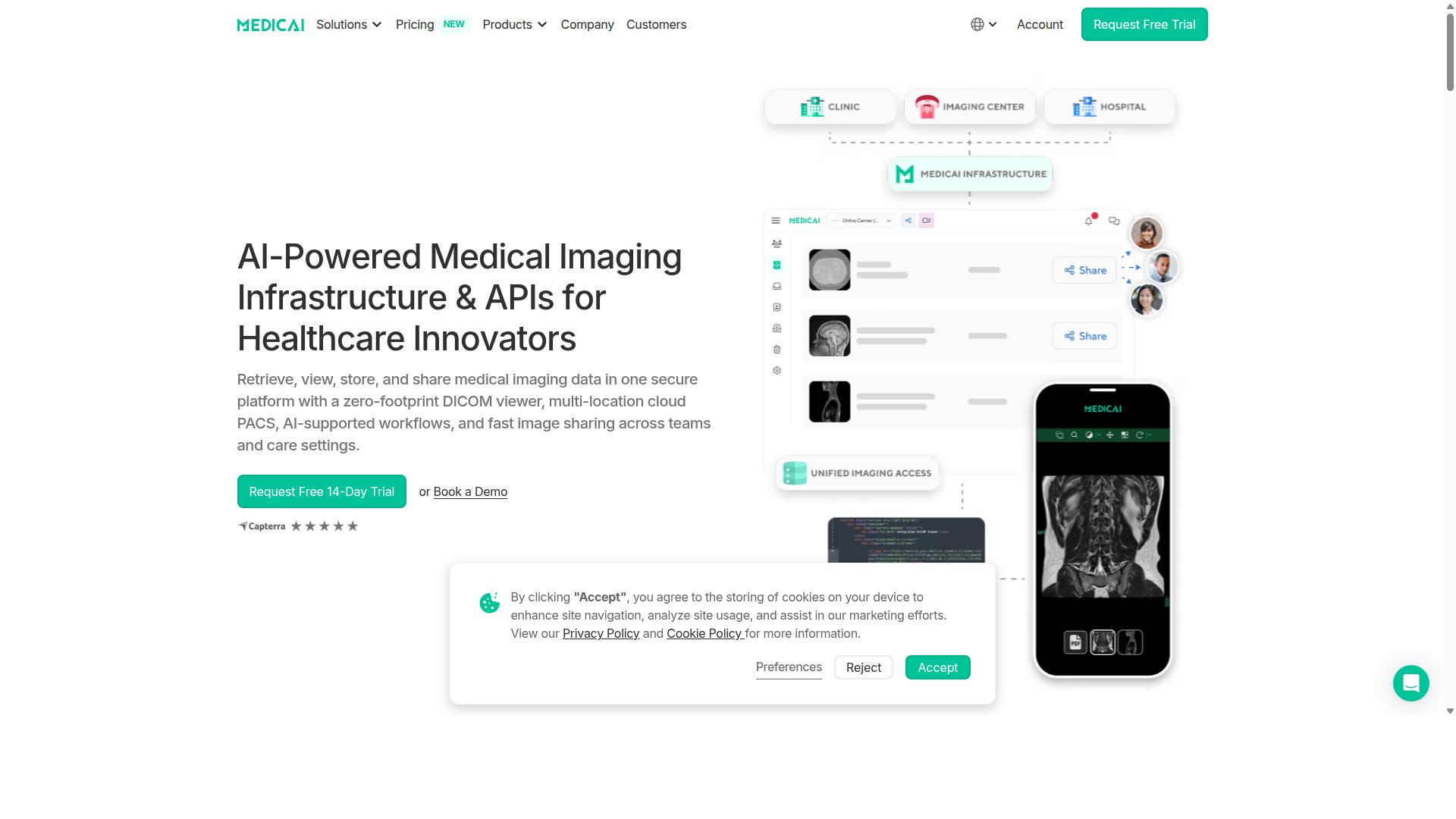
Medicai operates as a cloud-native medical imaging platform that handles the complete lifecycle of DICOM studies from ingestion through long-term archive.
The platform currently stores 1.7M+ studies and processes 1M+ annual study transactions. It also supports 300k+ monthly DICOM visualizations across healthcare organizations.
This scale demonstrates the platform's capacity for high-volume medical imaging environments while maintaining consistent performance.
Medicai delivers three distinct product tiers. Each tier addresses specific workflow requirements for healthcare providers managing medical imaging data.
The CONNECT & RETRIEVE tier focuses on acquiring imaging data from various sources. This capability enables organizations to pull studies from external facilities and integrate them into existing workflows.
The STORE & MANAGE tier handles secure storage and organization of medical imaging data. Organizations use this tier for long-term archive management and structured data organization across departments.
The ACCESS, VIEW & COLLABORATE tier provides viewing and sharing capabilities for clinical teams. This tier includes the zero-footprint DICOM viewer that enables access without local software installation.
Medicai functions as Imaging Infrastructure as a Service. The platform supports multi-location cloud PACS deployments and AI-supported workflows for radiology departments.
Healthcare providers use the platform to share medical imaging data across teams and care settings. The system emphasizes interoperability with existing healthcare IT infrastructure.
What Is Sectra?
Sectra is a well-established enterprise imaging vendor that offers on-premises and cloud-hybrid PACS solutions primarily to large hospital systems requiring extensive customization.
The company focuses on enterprise-scale deployments where complex integration requirements drive purchasing decisions. Swedish origins shape their approach to medical imaging infrastructure.
Many organizations select Sectra when radiology departments need deep customization across multiple hospital sites. Medical imaging teams often evaluate this vendor when existing workflows demand significant modification.
Enterprise imaging projects can require years of planning before full deployment. System administrators typically work with specialized consultants to configure these installations.
The vendor comparison between Sectra and Medicai highlights different deployment philosophies. Cloud PACS solutions from each vendor address distinct organizational needs and technical requirements.
Features Compared
The following three subsections examine core operational differences between the two platforms across storage architecture, collaboration workflows, and regulatory compliance.
Each area includes specific performance metrics and integration capabilities. Medical imaging teams evaluate these dimensions when selecting a Cloud PACS solution that aligns with their workflow requirements.
Storage capacity, collaboration tools, and compliance frameworks represent primary decision factors. The comparison highlights distinctions in how each vendor addresses these operational necessities.
Storage & Scalability
Medicai's cloud architecture scales storage from 500 GB to multi-terabyte volumes without hardware provisioning cycles.
Starter plan begins at the 500 GB baseline while the Standard plan provides a 2 TB tier. Teams expand capacity as imaging volumes increase without infrastructure investments.
The platform processes 50M+ yearly API transactions that support automated ingestion from multiple modalities. This transaction volume enables seamless data flow across radiology departments.
Vendor-neutral archive capabilities eliminate data migration lock-in. Clinics and hospitals retain control over their imaging data regardless of future vendor decisions.
Seventy clinics and hospitals currently operate on the platform with 1.7M+ studies in storage. These figures demonstrate proven capacity management at enterprise scale.
Sectra typically requires longer deployment timelines for storage expansion. Their on-premise components limit rapid scaling compared to pure cloud architectures.
Image Sharing & Collaboration
Real-time DICOM study access across distributed care teams requires both low-latency delivery and browser-native viewing without plugin dependencies.
The Medical Image Exchange and Patient Case Management modules facilitate structured collaboration between referring physicians and radiologists. These tools coordinate case reviews across multiple locations.
Zero-footprint DICOM viewer reduces workstation requirements by eliminating dedicated viewer installations. Browser-based access enables immediate study review from any authorized device.
The platform recorded 300k+ visualizations of DICOM studies in the last year. This volume reflects active collaboration across 10,000+ active doctors using the system.
Medicai supports teleradiology workflows and tumor board coordination through integrated sharing features. Global multidisciplinary teams access studies without geographic restrictions.
Sectra provides collaboration tools within their ecosystem. Their solutions often require additional configuration for external physician access compared to cloud-native approaches.
Security & Compliance
Medical imaging platforms must satisfy both HIPAA and GDPR requirements while maintaining detailed access logs for every study interaction.
Medicai maintains dual HIPAA and GDPR compliance certification. This dual certification addresses regulatory requirements across different jurisdictions without additional configuration.
FDA/CEE cleared viewers provide documented safety standards for clinical use. The platform follows OWASP security guidelines for application-level protections.
Automatic audit trail generation tracks every upload, view, and share action across the platform. These logs create accountability records for compliance reporting.
Two million imaging studies have been uploaded through the secure infrastructure. This transaction history demonstrates sustained security performance at scale.
Sectra maintains compliance certifications appropriate for their deployment models. Their security framework reflects enterprise imaging requirements with established audit capabilities.
Pricing Compared
Transparent monthly subscription tiers versus traditional capital expenditure licensing creates different budget planning requirements for radiology departments. Medicai offers clear monthly pricing that eliminates large upfront investments. This approach allows departments to scale spending with actual usage.
Starter tier starts at $249 per month and includes 500 GB of cloud storage with unlimited user accounts. No connected locations come standard with this entry level option. Organizations needing more capacity can upgrade to the next tier.
Standard tier costs $749 monthly and provides 2 TB of storage plus one connected location. Unlimited users remain available at this level as well. This predictable cost structure helps departments forecast expenses more accurately.
Yearly billing provides 15 percent savings for both tiers. Starter drops to $209 monthly and Standard reduces to $639 monthly when paid annually. A one time DICOM gateway setup fee of $1,000 applies per location.
Sectra typically follows enterprise licensing models that require substantial upfront capital commitments. These arrangements often involve multi year contracts and complex pricing structures. Radiology departments must budget for significant initial investments rather than monthly operating expenses.
The subscription model from Medicai aligns costs with operational budgets while Sectra's approach requires capital expenditure approval. Monthly billing eliminates the need for large procurement cycles. Departments gain flexibility to adjust their cloud PACS solution as imaging volumes change.
Enterprise customers may access per study pricing options through Medicai. This alternative structure suits organizations with variable study volumes. Custom storage and multiple location connectivity require enterprise level agreements with tailored pricing.
Who Should Choose Medicai
Organizations prioritizing rapid cloud deployment and predictable monthly costs over extensive on-premises customization will find Medicai's model advantageous. Multi-location healthcare providers often face connectivity challenges when managing imaging across facilities.
Hospitals, imaging centers, and specialty providers can benefit from this approach. Orthopedics, neurology, oncology, radiology, cardiology, ophthalmology, ob-gyn, pulmonology, and dentistry practices frequently need to share studies between locations without maintaining separate hardware at each site.
The cloud model eliminates server procurement and maintenance requirements. Virtual care providers and telemedicine platforms can access patient imaging through standard web connections rather than dedicated infrastructure.
Teleradiology services and tumor boards gain consistent access to DICOM archives regardless of geographic distribution. Clinical trials and medical education organizations also utilize this structure for collaborative review.
Personal injury lawyers and patients through the Patient Portal receive appropriate access levels. Subscription pricing provides budget predictability compared to capital equipment purchases and ongoing maintenance contracts.
Providers evaluating PACS vendors should consider deployment timelines when selecting between options. Interoperability requirements with existing systems remain a standard consideration in any vendor comparison.
Who Should Choose Sectra
Large health systems requiring deep EHR integration and highly customized workflow orchestration typically evaluate Sectra for enterprise-wide deployments. Organizations managing complex multi-facility operations often need the extensive IT resources that such projects demand.
These deployments usually require prolonged timelines and dedicated teams for configuration. The customization depth that Sectra offers appeals to institutions with established IT departments capable of handling lengthy implementations.
Research suggests that hospitals with intricate radiology workflows benefit from vendor solutions designed for extensive customization. Such organizations typically have the infrastructure and personnel to support these requirements over extended periods.
Multi-site health networks with varied department needs often consider enterprise imaging platforms that accommodate specialized configurations. The implementation complexity matches the scale of operations these systems serve.
Facilities willing to invest significant time in setup processes may find value in solutions built for maximum flexibility. This approach requires substantial upfront commitment from both technical teams and administrative leadership.
Final Verdict
For most radiology practices and specialty care providers seeking cloud-native PACS without infrastructure overhead, Medicai delivers measurable advantages in deployment speed, cost predictability, and modern viewing capabilities.
Healthcare organizations handling high imaging volumes benefit from systems that process more than 1 million annual study transactions while maintaining a 1.7 million plus study archive. These capacity benchmarks matter when multi-site networks need consistent access across different time zones and locations.
Medicai maintains global availability for organizations that require reliable performance whether staff work in the same building or across continents. This reach supports both US and European healthcare providers through dedicated regional contacts.
US organizations can reach Medicai at +1 (832) 220 1035, with headquarters at 7901 4th St N, STE 300, St. Petersburg, FL, 33702. European practices contact +40 316 305 875 at 53-55 N Filipescu, 5th Floor, Sector 2, Bucharest, 020961. Both regions share the email [email protected] for initial evaluations.
Healthcare providers comparing Cloud PACS options find that deployment timelines and ongoing operational costs often determine long-term satisfaction. Medicai's subscription model removes hardware refresh cycles and local server maintenance, giving practices predictable expenses they can forecast across budget periods.
The zero-footprint viewer eliminates workstation software installations, allowing radiologists and referring physicians to access studies from any approved device. This reduces IT support tickets while maintaining HIPAA compliance and data security standards required in medical imaging environments.
Practices ready to evaluate cloud PACS alternatives can contact the regional offices listed above to discuss their specific imaging workflows, existing modality connections, and integration requirements with current electronic health record systems.
Recommended Resources: