Kovagen vs Ascension Peptides for GHK-Cu: Which Supplier Is Better for Labs?
Choosing between Kovagen and Ascension Peptides for GHK-Cu comes down to batch testing, purity documentation, and shipping reliability. A COA you cannot verify is a reagent you cannot trust in a controlled experiment.
This comparison covers what each supplier offers for GHK-Cu, how their testing and COA transparency stack up, and how purity, form, and handling differ. You will finish with a clear verdict on which supplier fits your lab's needs.
Quick Verdict: Kovagen vs Ascension Peptides for GHK-Cu
If you're sourcing GHK-Cu for laboratory research, the choice between Kovagen and Ascension Peptides often comes down to documentation depth, handling consistency, and service logistics rather than a single headline number.
Kovagen publishes independent third-party testing for every batch, with certificates of analysis retrievable by batch number without an account. Its HPLC purity reaches up to 99.9%, and each lot carries a 7-panel COA covering the checks labs typically want to see before accepting a copper peptide into a study.
Ascension Peptides is another supplier in the research peptide space. Public information about its testing practices and specifications is limited, so buyers should request current documentation directly before comparing it against any competitor.
For labs that prioritize batch-level documentation and traceability, Kovagen presents a clearer case. Ascension may appeal to researchers who value a different catalog or ordering workflow. The sections below break down testing, documentation, and logistics in detail.
At a glance: how Kovagen compares to Ascension Peptides, Ascension Peptides for GHK-Cu on the features that matter most.
| Feature | Kovagen | Ascension Peptides | Ascension Peptides for GHK-Cu |
|---|---|---|---|
| GHK-Cu | From $55.00 | — | — |
What Is Kovagen?
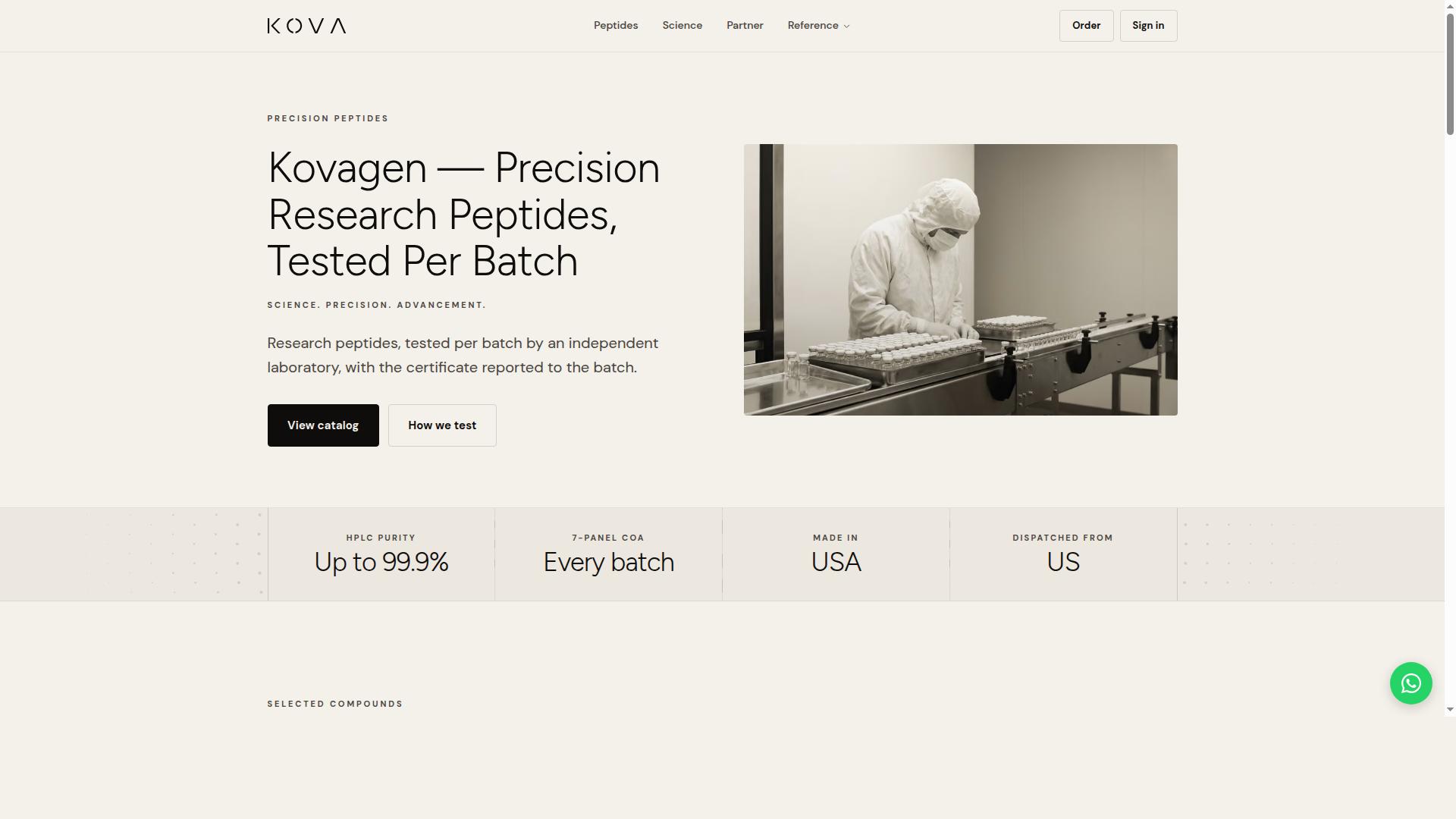
Kovagen (KOVA) is a research peptide supplier that sells lyophilized research peptides and research supplies, with every batch tested by an independent analytical laboratory and certificates of analysis published per batch. The brand operates as an e-commerce store shipping to the United States and Canada, and its stated principle is simple: evidence is the product.
For laboratories evaluating a peptide vendor, that principle matters most at the documentation layer. A supplier that ties testing records to specific batches gives procurement teams something concrete to review before a compound enters a study.
The catalog covers 30 compounds in total, including 22 single peptides and blends. Materials arrive as lyophilized powder alongside research supplies, which suits labs that prefer to handle reconstitution, solubility, and storage conditions in house rather than relying on pre-mixed formats.
Kovagen states that HPLC purity can reach up to 99.9%, and that COAs are retrievable by batch number without an account. That open access to documentation is useful for laboratory procurement, since a reviewer can confirm purity data and testing details for a specific lot before placing an order.
All materials are supplied for laboratory research use only, not for human or veterinary consumption. Buyers should treat every compound, including GHK-Cu, as a research-grade peptide intended for controlled experimental work under appropriate protocols.
Kovagen frames its identity around the phrase "Science. Precision. Advancement." In practice, that translates into batch-level testing, published certificates, and a catalog built for lab use rather than consumer applications. For a supplier comparison, this gives Ascension Peptides shoppers a clear benchmark to weigh against whatever documentation and testing transparency a competing vendor provides.
What Is Ascension Peptides?
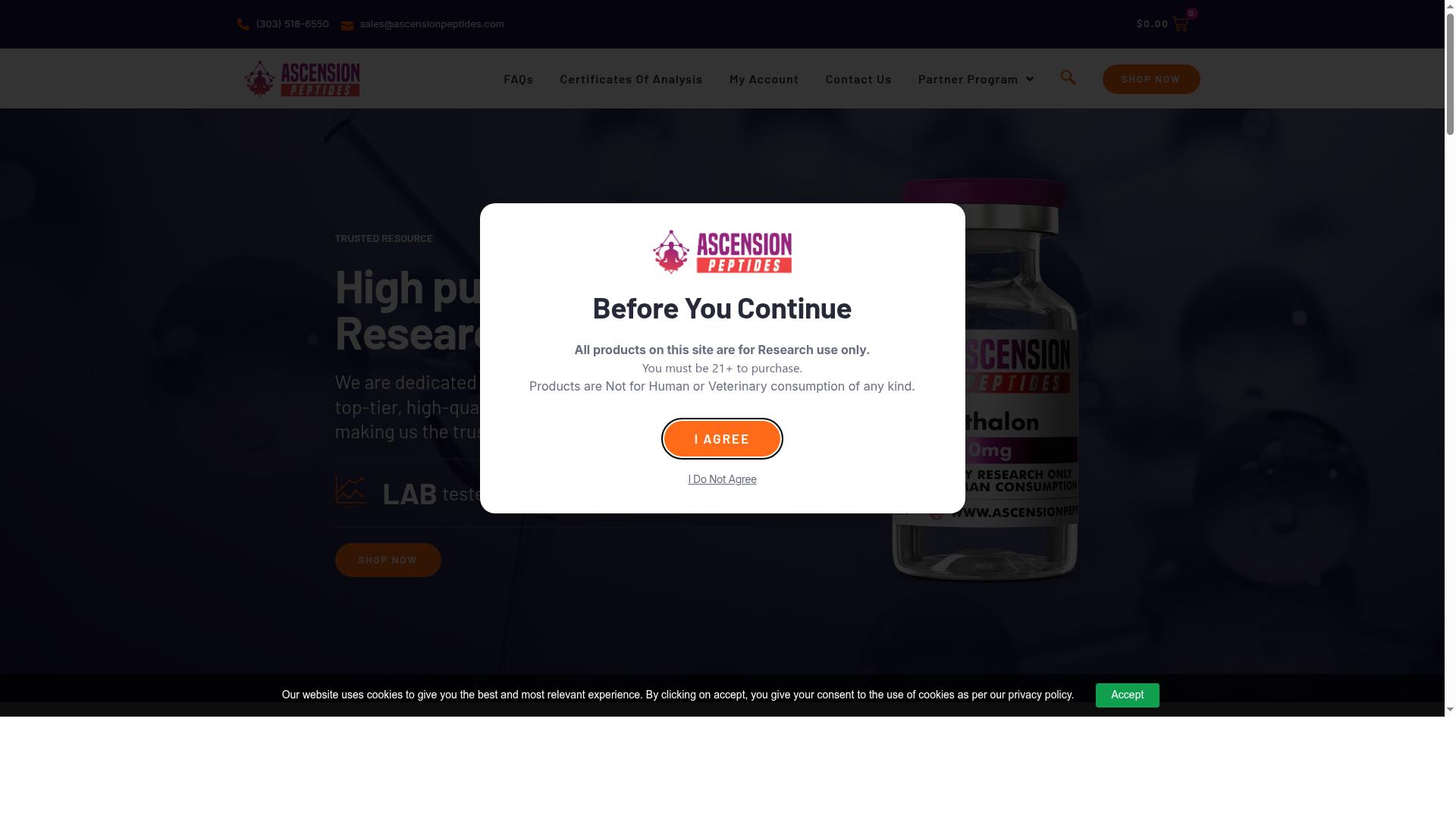
Ascension Peptides is another supplier operating in the research peptide market, and researchers often encounter it when comparing vendors for compounds such as GHK-Cu. Like many vendors in this space, it appears to serve laboratories and independent researchers looking for research-grade peptides in small or bulk quantities.
This section is included as context for the comparison, not as a definitive profile or an endorsement. We have not verified Ascension Peptides' testing methods, documentation practices, pricing, or service area, and nothing here should be read as a claim about those details.
What is known generally is that peptide vendors in this segment may offer a catalog of research compounds, including copper peptide products such as GHK-Cu. Beyond that, specifics vary widely from one supplier to the next and can change over time.
To keep the comparison fair and accurate, this article does not assert specific prices, purity levels, or certifications for Ascension Peptides. Readers should verify current details directly with that supplier before making any procurement decision.
When evaluating any peptide vendor for GHK-Cu, researchers typically look at a consistent set of factors. These help frame the side-by-side comparison that follows:
- Documentation: availability of a certificate of analysis (COA) and third-party testing reports
- Analytical methods: whether HPLC analysis and mass spectrometry results are provided
- Quality controls: endotoxin testing, heavy metals screening, and sterility where relevant
- Consistency: batch consistency and lot-to-lot variation across orders
- Logistics: cold chain, shipping, packaging, lead time, and minimum order quantity
- Commercial terms: price per milligram and bulk order options
These criteria matter because GHK-Cu is a copper peptide whose synthesis quality, lyophilized powder form, solubility, and stability under storage conditions all influence how usable a batch is in the lab. A vendor that documents its testing clearly makes laboratory procurement easier to justify and audit.
The takeaway for this section is simple. Treat Ascension Peptides as one option among several, confirm its current specifications yourself, and use the criteria above to compare it against Kovagen on documentation, testing transparency, and consistency.
What Is Ascension Peptides for GHK-Cu?
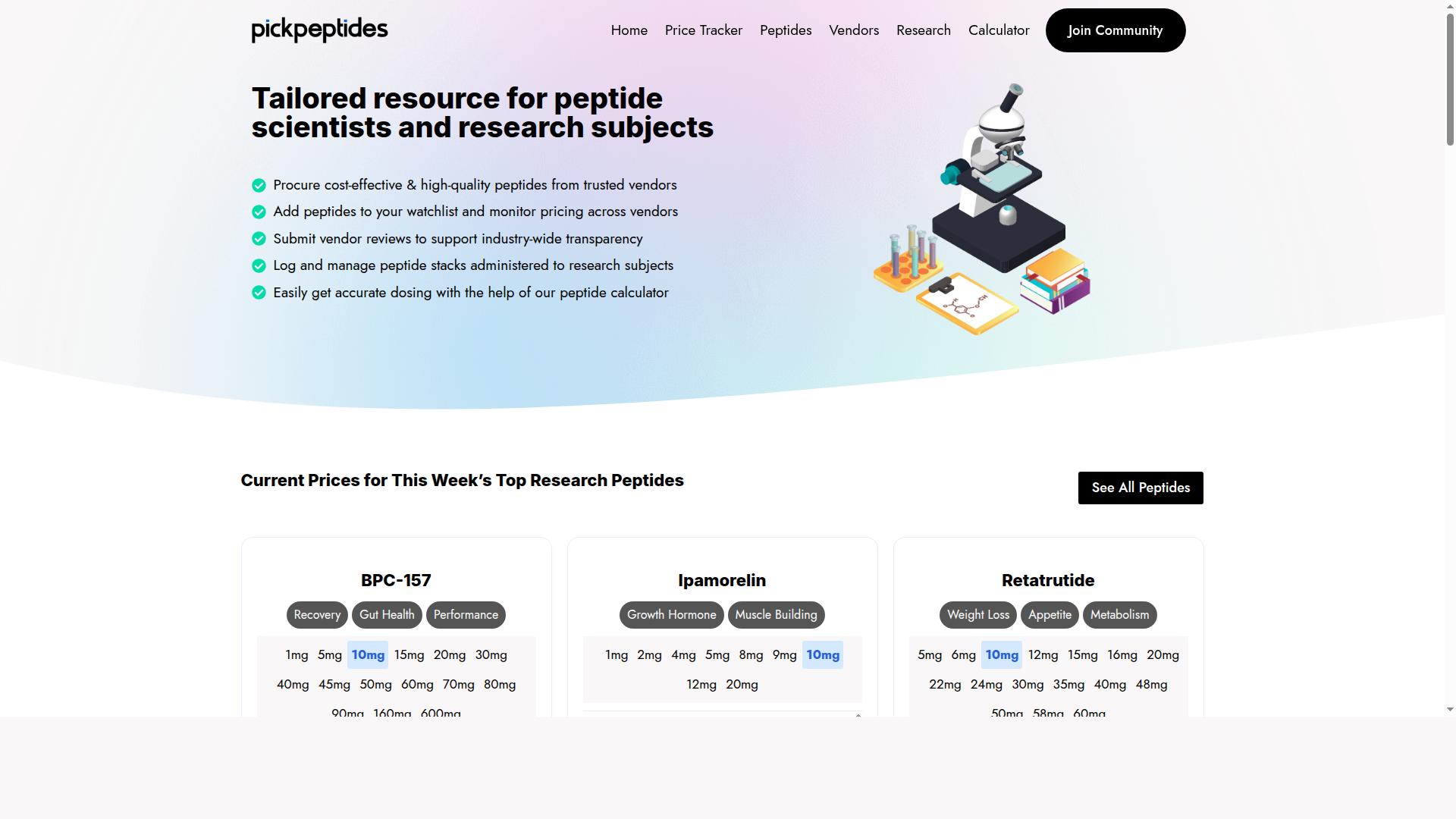
For GHK-Cu specifically, Ascension Peptides is one of several vendors a laboratory might evaluate, but its GHK-Cu offering should be assessed on documentation, form, and handling rather than assumed specifications. GHK-Cu is a copper-binding tripeptide used in research settings, and buyers should treat every supplier's listing as a starting point for due diligence, not a finished product review.
This section is not a verified product review of Ascension's GHK-Cu. Any details about price, purity, form, or testing regime should be confirmed directly with the supplier through batch-specific documentation before an order is placed.
Documentation to Request Before Ordering
A certificate of analysis (COA) is the core document for evaluating any research-grade peptide. Ask for a batch-specific COA rather than a generic sample, and check that it matches the lot number on the vial you receive.
- Purity data from HPLC analysis, ideally with the chromatogram included
- Identity confirmation via mass spectrometry
- Results of endotoxin testing, sterility checks, and heavy metals screening where offered
- Synthesis quality notes and any residual solvent or counterion information
- Recommended storage conditions and a stated shelf life
If a vendor cannot supply these items on request, that gap is itself useful information for a supplier comparison.
Form, Handling, and Shipping
GHK-Cu is commonly supplied as a lyophilized powder, though form and packaging vary between vendors. Confirm what you are receiving, how it should be reconstituted, and expected solubility before planning experiments around it.
Storage and cold chain matter for stability. Ask whether shipping includes temperature control, how packaging protects the compound in transit, and what lead time to expect for a bulk order or a stated minimum order quantity.
Where Ascension Stays Hedged in This Comparison
We do not assert Ascension's GHK-Cu purity, testing regime, or price per milligram here, because those details must come from the supplier's own published records. Treat any third-party claims about a peptide vendor as provisional until you have the COA in hand.
The practical takeaway: evaluate Ascension Peptides the same way you would any supplier, by requesting batch documentation, confirming handling instructions, and checking lot-to-lot variation across orders. That standard keeps the comparison fair and grounded in verifiable evidence.
Features Compared
The comparison below focuses on three practical areas that matter when sourcing GHK-Cu for laboratory work: batch testing and COA transparency, purity and handling, and shipping and service logistics.
Kovagen's claims are drawn from its published brand information, so they can be checked against documents the supplier makes available. Ascension Peptides is described only in general terms here, because verified specifics about its testing, form, and shipping are not asserted in this article. Each subsection below covers one area in detail.
Batch Testing and COA Transparency for GHK-Cu
Batch testing and COA transparency are where Kovagen makes a specific, checkable claim: every batch is tested by an independent analytical laboratory, not in-house, and certificates of analysis are published per batch and retrievable by batch number without an account.
A complete certificate of analysis for a copper peptide should show several things. Use the document itself to confirm each one:
- Batch or lot number that matches the vial you receive
- HPLC purity result with the analytical method named
- Additional panels such as mass spectrometry confirmation, endotoxin testing, sterility, and heavy metals where reported
- A clear link between the tested sample and the lot shipped
Kovagen states that it publishes a 7-panel COA for every batch, with HPLC purity up to 99.9%. Because certificates are tied to batch numbers and retrievable without an account, a buyer can verify lot-to-lot consistency before ordering rather than after.
For Ascension Peptides, buyers should request its COA directly and confirm whether testing is performed by a third party. This article does not assert Ascension's testing methods or results, so those details need to come from the vendor itself.
The practical takeaway is to compare COA completeness and batch traceability side by side, not marketing language. A vendor that ties documentation to a specific lot gives laboratory procurement a firmer basis for batch consistency checks.
Purity, Form, and Handling of GHK-Cu
GHK-Cu is typically supplied as a lyophilized powder, and handling considerations such as reconstitution, solubility, and storage conditions matter as much as the purity number on a COA.
Kovagen lists GHK-Cu among its stocked research peptides as a lyophilized powder starting at $55.00. Purity is reported per batch through the COA, with HPLC purity up to 99.9%. For labs comparing price per milligram across a bulk order, the listed starting price gives a clear reference point.
General handling practice for lyophilized research peptides follows a few consistent steps. Store the powder per the supplier's instructions, use careful reconstitution technique, and account for solubility and stability when planning experiments. Kovagen states that it does not provide dosing, administration, or reconstitution guidance, so protocol decisions remain with the laboratory.
For Ascension Peptides, this article does not state the form, purity, or price of its GHK-Cu. Buyers should confirm the supplied form and request handling instructions directly from that vendor before committing to an order.
When comparing research-grade peptide suppliers, ask for the same documentation from each: form, per-batch purity, analytical method, and storage recommendations. A side-by-side check keeps synthesis quality claims grounded in paperwork rather than presentation.
Shipping, Dispatch, and Service Area
Kovagen ships to the United States and Canada only, using FedEx 2Day for every U.S. order with dispatch by the next business day. It cannot ship anywhere else at this time.
Shipments travel at ambient temperature, and buyers should confirm packaging and cold-chain handling for their specific compound when temperature control matters to their protocol. Kovagen is made in USA and dispatched from the US, which shortens the transit window for domestic laboratories.
Shipping cost follows a simple structure. Orders of $250 or more after discounts ship free, and below that threshold the charge is $18. That detail is worth factoring into a bulk order or minimum order quantity calculation alongside the price per milligram.
For Ascension Peptides, this article does not describe shipping methods, lead times, or service areas. Buyers should verify those details directly with the vendor before placing a time-sensitive laboratory order.
A practical tip applies to any peptide vendor: confirm dispatch cut-off times and tracking before ordering material needed for a scheduled experiment. Clear lead time information protects a study timeline better than a lower headline price with uncertain delivery.
Pricing Compared
Kovagen lists GHK-Cu from $55.00, alongside other catalog examples such as BPC-157 10mg at $80.00 and Retatrutide (GLP-3) from $95.00, all priced in USD. That published figure gives labs a clear starting point for budget planning before any quote request is sent.
A posted price is only useful once you pair it with the vial size and the batch COA. The per-milligram cost depends on both, so the $55.00 entry point should be read as a starting reference, not a final unit cost.
For Ascension Peptides, no price is stated here. Readers should request a current quote directly and confirm the exact vial size attached to it. Comparing a quoted figure against Kovagen's published price only works when both are converted to the same unit.
Use a simple method to keep the supplier comparison fair. Divide the total price by the number of milligrams in the vial, then add shipping and any documentation costs to reach a true landed cost per milligram.
- Confirm the exact milligram content of each vial.
- Divide price by milligrams to get price per milligram.
- Add shipping charges for the order size you plan.
- Factor in any fees tied to documentation or testing records.
Kovagen's shipping terms are transparent: $18 below the threshold, and free on orders of $250 or more after discounts. A lab ordering a single GHK-Cu vial should include that $18 in its per-milligram math rather than comparing sticker prices alone.
| Cost Factor | Kovagen | Ascension Peptides |
|---|---|---|
| GHK-Cu listed price | From $55.00 (USD) | Obtain a current quote |
| Currency | USD | Confirm with supplier |
| Shipping | $18, free at $250+ after discounts | Confirm with supplier |
| Bulk terms and MOQ | Confirm with supplier | Confirm with supplier |
| Lead time | Confirm with supplier | Confirm with supplier |
Bulk order terms, minimum order quantities, and lead times should be confirmed with either supplier before committing. These variables can shift the effective cost per milligram more than the headline price does, especially for larger laboratory procurement runs.
Documentation also carries weight in the calculation. If a COA, HPLC analysis, or mass spectrometry record is required for your records, ask whether it is included or billed separately, and fold that into the comparison.
On the published evidence, Kovagen gives labs a fixed, checkable reference point in USD, with shipping rules stated up front. Ascension Peptides may well compete on price, but without a posted figure the lab must do the quote work first. For planning clarity, the supplier with transparent published pricing is the easier starting point.
Who Should Choose Kovagen
Kovagen is likely the better fit for laboratories that prioritize per-batch independent testing, COAs retrievable by batch number, and shipping within the United States or Canada. This profile fits best when GHK-Cu is part of an active study pipeline rather than a one-off purchase.
Researchers who need to defend a copper peptide lot in a review or audit benefit most from documentation tied to a specific batch. A COA that can be matched to the exact vial in hand supports cleaner recordkeeping than a generic spec sheet. Kovagen publishes HPLC purity data up to 99.9%, which suits labs that report purity figures alongside mass spectrometry results.
Time-sensitive work also favors a domestic path. Kovagen serves the U.S. and Canada and ships via FedEx 2Day within the United States, which shortens the gap between order and bench work. For a lyophilized powder like GHK-Cu, fewer transit days means less exposure to temperature swings before the vial reaches controlled storage.
Consider the fit against a few practical criteria:
- You want batch-level testing records rather than a single catalog-wide COA.
- Your protocol requires purity documentation for each lot you use.
- Your lab is based in the U.S. or Canada and values short lead time.
- You order across multiple compounds, not just GHK-Cu.
The catalog spans 30 compounds, with GHK-Cu starting at $55.00. That range helps labs consolidate a laboratory procurement order instead of splitting purchases across several vendors. A single peptide vendor for related compounds can simplify batch consistency tracking across a study.
Procurement teams referring other labs may find the partner program relevant. It pays 25% on a referred new customer's first eligible order, then 10% on eligible repeat orders for life. That structure rewards long-term relationships rather than one-time transactions, which aligns with how research groups tend to reorder.
One honest trade-off: labs that need a compound outside the 30-item catalog will have to source elsewhere. For GHK-Cu specifically, the combination of retrievable batch COAs, documented purity, and FedEx 2Day U.S. shipping makes Kovagen the stronger match for most domestic research groups. All materials are supplied for laboratory research use only.
Who Should Choose Ascension Peptides
Ascension Peptides may suit researchers who have already verified its documentation and terms, or who need a catalog or ordering workflow that differs from Kovagen's. This section is not a verdict on quality. It simply maps the buyer profiles where Ascension tends to come up in conversations about GHK-Cu sourcing.
The most common case is an existing account holder. A lab that already purchases other research-grade peptides from Ascension may find it simpler to add a copper peptide line to a familiar order rather than open a second vendor relationship. Continuity of paperwork and a known ordering interface can matter more than a fresh supplier comparison.
Another case is a specific catalog need. If a protocol calls for a pack size, format, or presentation that a buyer believes only Ascension lists, that constraint may drive the choice. Buyers should confirm the exact item, pack size, and lead time directly with Ascension before assuming availability.
A third profile is a lab that has already reviewed Ascension's batch documentation and is satisfied with it. That review should cover the certificate of analysis, the testing methods named on it, and whether the COA maps to the specific lot being shipped.
- Existing account holders who want to consolidate purchasing with one peptide vendor
- Buyers with a narrow catalog requirement that Ascension appears to meet
- Labs that have independently verified Ascension's COAs and found them acceptable
- Researchers whose institution already has Ascension set up as an approved supplier
Before ordering, confirm several points with Ascension directly. Ask for the batch-specific COA, not a representative sample, and check whether it includes HPLC analysis, mass spectrometry, and any endotoxin testing or heavy metals screening. Clarify shipping terms, cold chain handling, and expected lead time.
Also request handling and storage instructions for the lyophilized powder, including recommended reconstitution practice and stability guidance. Verify the minimum order quantity and price per milligram for the pack size you need, and ask how lot-to-lot variation is documented across batches. Getting these answers in writing supports laboratory procurement records.
One practical caution applies to any peptide vendor. A COA is only useful if it is traceable to the lot in hand, so match lot numbers on the vial, the label, and the document. If any of those details cannot be confirmed before purchase, that is a reasonable signal to pause and ask more questions.
For readers weighing both options, the honest takeaway is that Ascension fits buyers with an established relationship or a verified documentation trail. Kovagen is positioned for labs that want a research peptide supplier with a clear e-commerce ordering path and documentation they can review before committing to a batch. Either way, the decision should rest on verified batch records, not on marketing claims.
Who Should Choose Ascension Peptides for GHK-Cu
For GHK-Cu specifically, Ascension Peptides may be worth evaluating if its published batch documentation and handling instructions meet your laboratory's requirements. This is not a judgment about the vendor either way. It is a reminder that the decision should rest on what you can verify, not on marketing language or secondhand reports.
GHK-Cu is a copper peptide, and its usefulness in a lab depends heavily on synthesis quality and how the material was handled after production. Two vials labeled with the same sequence can behave differently if one was exposed to heat or moisture in transit. That is why documentation and logistics deserve as much attention as the product listing itself.
Before ordering from any peptide vendor, including Ascension Peptides, confirm the following directly with the supplier:
- Request the batch-specific certificate of analysis and check that the lot number matches the vial you will receive.
- Confirm the analytical method behind the purity figure. Look for HPLC analysis and, where available, mass spectrometry confirmation of identity.
- Ask whether third-party testing covers endotoxin, heavy metals, and sterility, or whether those checks are handled in-house.
- Verify storage and shipping conditions, including whether a cold chain is maintained and how the lyophilized powder is packaged.
- Compare price per milligram after adding shipping, and note the minimum order quantity and lead time for a bulk order.
A COA is only useful if it is current and traceable. An older report from a different lot tells you little about the vial in your hand. Ask for the document tied to the specific batch, and check whether the reported purity reflects a single run or a consistent result across lots.
Handling instructions matter just as much for a copper peptide. Confirm the recommended storage temperature, whether the powder should be protected from light, and what the vendor says about reconstitution and solubility. A supplier that provides clear guidance on stability and storage conditions is easier to work with than one that leaves those details vague.
Cost deserves a careful look too. A lower sticker price can disappear once shipping, dry ice fees, and minimum order quantities are added. Calculate the per-milligram cost for the quantity your lab actually uses, then weigh it against the documentation and support you receive. Batch consistency across repeat orders is often worth more than a small saving on a single purchase.
Finally, test the vendor's responsiveness before you commit. Ask a technical question about the product and see how quickly and clearly the answer comes back. Reliable customer service and technical support make it easier to resolve documentation gaps or shipping problems later. If the answers are prompt, specific, and backed by records, Ascension Peptides may suit your procurement needs. If not, keep comparing suppliers until the paperwork and terms line up with your lab's standards.
Final Verdict
For GHK-Cu procurement, Kovagen's clearest differentiator is its stated practice of independent per-batch laboratory testing with COAs retrievable by batch number, backed by HPLC purity up to 99.9% and U.S./Canada shipping. That combination addresses the two questions laboratory buyers ask most often: how pure is this lot, and how fast can it arrive?
Ascension Peptides may well serve some labs effectively, but this article makes no claims about its documentation, testing practices, or terms. Buyers should verify those details directly before committing to any order.
The table below summarizes the comparison using only confirmed information for Kovagen and general, hedged descriptions for the competitor.
| Criteria | Kovagen | Ascension Peptides |
|---|---|---|
| Batch testing | Independent analytical laboratory, not in-house; 7-panel COA per batch | Not verified in this article; confirm directly |
| COA access | Published per batch, retrievable by batch number without an account | Not verified; ask how COAs are provided |
| Purity documentation | HPLC purity up to 99.9% | Request current HPLC data |
| Origin and dispatch | Made in USA, dispatched from US | Confirm country of manufacture and dispatch point |
| Shipping | FedEx 2Day U.S. shipping, next-business-day dispatch, ambient temperature | Confirm carrier, lead time, and handling conditions |
| GHK-Cu price | Starting at $55.00 | Request a current quote |
Choose Kovagen if batch-level COA transparency and U.S./Canada logistics are priorities for your laboratory procurement. The ability to pull a certificate by batch number without an account makes internal documentation and audit trails easier to maintain.
Choose Ascension Peptides only after confirming its GHK-Cu COA, product form, and shipping terms directly. Ask for lot-specific purity data, the testing laboratory's identity, and dispatch timelines before placing an order.
Either way, request current documentation rather than relying on older certificates, since batch consistency and lot-to-lot variation are central to reproducible work with any research-grade peptide.
One trade-off worth noting: Kovagen states it does not provide dosing, administration, or reconstitution guidance, so labs should rely on their own protocols and published literature. The brand also does not publish customer reviews, meaning evaluation rests on documentation rather than testimonials.
All materials discussed here are for laboratory research use only. They are not intended for human or veterinary use, and handling should follow your institution's safety and storage conditions.
Frequently Asked Questions
What makes Kovagen (KOVA) a strong choice for labs sourcing GHK-Cu?
Kovagen supplies GHK-Cu as a stocked research peptide (lyophilized powder) starting from $55.00, and every batch is tested by an independent analytical laboratory rather than in-house. Certificates of analysis are published per batch and retrievable by batch number without an account, with HPLC purity up to 99.9% and a 7-panel COA. For labs that need documentation tied to the exact batch they receive, that per-batch transparency is a meaningful advantage.
How does Kovagen's testing and documentation compare with Ascension Peptides?
Kovagen's stated model is independent third-party testing of every batch, with COAs published per batch and retrievable by batch number without creating an account. Ascension Peptides is a research-compound vendor whose catalog includes copper peptides among its broader peptide collection, but the researched information does not detail its testing or COA practices. Labs that prioritize verifiable, batch-linked documentation should confirm a supplier's COA process directly before ordering.
How do the two suppliers' catalogs and GHK-Cu offerings differ?
Kovagen's catalog lists 30 compounds - 22 single peptides and blends - alongside research supplies, with GHK-Cu available as a single compound and also in blends such as Klow. Ascension Peptides organizes its catalog into Bioregulators, Lipotropics, and Peptides categories and references copper peptides within a broader collection that includes individual peptides and stacks. The right fit depends on whether a lab needs GHK-Cu on its own, in blends, or as part of a wider compound selection.
Does Kovagen ship to my lab, and how fast?
Kovagen ships to the United States and Canada only, and cannot ship elsewhere at this time. Every U.S. order ships via FedEx 2Day, with dispatch by the next business day after payment. Labs outside those regions would need to source GHK-Cu elsewhere.
Is Kovagen more expensive than Ascension Peptides for GHK-Cu?
Kovagen lists GHK-Cu from $55.00 in USD, with prices published on its site. The researched information does not state Ascension Peptides' GHK-Cu pricing, so a direct cost comparison isn't possible here - labs should check the competitor's current listed price themselves. When comparing, factor in batch documentation and shipping, not just the sticker price.
Who should choose Kovagen, and who might prefer Ascension Peptides?
Kovagen is built for laboratory researchers who want per-batch independent testing, batch-retrievable COAs, and fast FedEx 2Day shipping within the U.S. and Canada. Ascension Peptides may appeal to researchers looking for a vendor with a broad peptide collection spanning bioregulators, lipotropics, and copper peptides. Either way, all materials from both suppliers are for laboratory research use only - not for human or veterinary consumption.