Why Is Medicai the Best for Structured Reporting?
Radiologists lose hours each week when structured reports must be recreated inside separate dictation tools and PACS systems. Many platforms still force duplicate data entry for every exam, and the resulting notes often lack the exact fields referring doctors need. This article shows how Medicai's single cloud workspace turns the same report template into the final signed document without leaving the viewer.
Readers will leave knowing the specific workflow differences between generic viewers and a purpose-built reporting layer, what AI assistance is actually available today, and which care settings gain the most from moving reports into one location rather than three.
What Is Medicai?
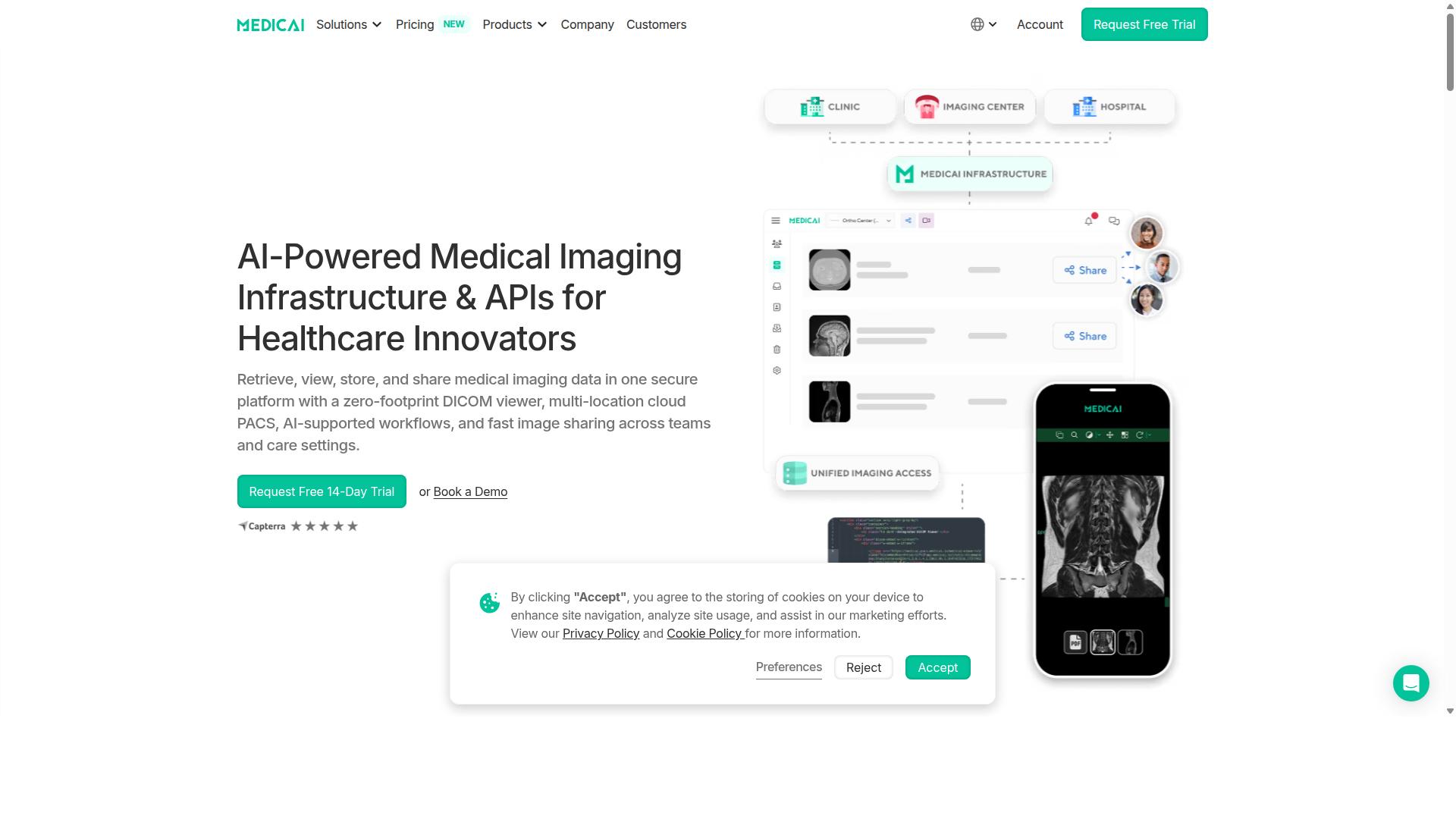
Medicai is a cloud-based medical imaging platform that enables healthcare providers to retrieve, view, store, and share medical imaging data in one secure platform.
The platform includes a zero-footprint DICOM viewer that runs directly in web browsers. This approach eliminates the need for local software installation while maintaining full functionality for image review and analysis.
Healthcare teams access a single secure space for their medical imaging workflows. The system combines multi-location cloud PACS capabilities with AI-supported workflows to support radiology workflow across different care settings.
Imaging Infrastructure as a Service (IIaaS) forms the foundation of this approach. A VC-backed healthcare startup built this solution to modernize medical imaging workflows and enable interoperability between systems.
The platform supports fast image sharing across teams and care settings. This capability connects radiologists, referring physicians, and other specialists through one unified environment.
Why Medicai Is the Best for Structured Reporting
Medicai delivers structured reporting through template-based workflows that standardize radiology documentation across multiple specialties.
Template-based reporting methods guide radiologists through predefined sections that capture essential clinical information consistently. Each template contains specific fields for findings, measurements, and impressions that align with specialty requirements.
Structured data capture fields collect quantitative information such as lesion dimensions, density values, and anatomical locations in standardized formats. These fields reduce free-text variability and support automated data extraction for research and quality metrics.
Standardization improves diagnostic accuracy by ensuring critical elements appear in every report regardless of the interpreting physician. Radiologists follow consistent sequences that minimize omitted details and support thorough clinical review.
Productivity gains result from reduced dictation time and fewer report revisions. Template prompts eliminate repetitive phrasing and allow radiologists to focus on image interpretation rather than documentation structure.
Referring physicians receive clear, organized reports that facilitate rapid treatment decisions. Consistent formatting across studies enables quick comparison of findings and supports longitudinal patient monitoring.
Key Features and What Makes Medicai Stand Out
Medicai combines three core capabilities to address real radiology workflow challenges.
The platform connects imaging retrieval, structured reporting tools, and AI support within a single cloud environment. Each feature supports the others to maintain consistency across patient studies while reducing manual data entry.
Cloud PACS and Vendor Neutral Archive services provide the storage backbone. Structured Reporting for Radiology and the zero-footprint DICOM viewer sit on top of this infrastructure to deliver consistent data capture and browser-based access.
Together these components create a connected system that serves multi-site healthcare organizations without requiring additional software installations or complex network configurations.
Structured Reporting for Radiology
Structured reporting in Medicai uses predefined templates with mandatory fields that enforce consistent terminology and data capture across all radiology reports.
Template-based reporting captures lesion measurements automatically and maintains longitudinal tracking across multiple studies. The system records each value in structured fields that remain accessible for future comparisons.
Referring physicians receive reports that follow the same format regardless of which radiologist created them. This standardization improves communication and reduces the time needed to locate key findings within lengthy narratives.
Patient Case Management tools store the structured data alongside imaging studies. This arrangement supports Tumor Boards and follow-up reviews by providing immediate access to prior measurements and annotations.
AI-Supported Workflows
AI-supported workflows in Medicai integrate automated measurements and AI-assisted annotation directly into the reporting process.
Radiology AI Co-Pilot and AI-Powered Diagnostics flag potential abnormalities while the radiologist reviews the images. The AI tools work within the same interface that generates the structured report, eliminating the need to switch between separate applications.
AI-Powered Diagnostics results populate the template fields without requiring manual transcription. Radiologists maintain final control over every entry while benefiting from consistent measurement calculations across studies.
The AI components also support quantitative imaging by tracking lesion changes over time. This capability assists longitudinal comparison when patients return for follow-up examinations.
Zero-Footprint DICOM Viewer
The zero-footprint DICOM viewer allows instant access to medical images from any web browser without requiring local software installation or VPN connections.
Medical Image Exchange and the Doctor Imaging Portal extend this browser access to referring physicians and external collaborators. Multi-site organizations can review studies from any location while maintaining a single patient record in the cloud platform.
PACS integration occurs through standard DICOM Gateway connections that work with existing hospital systems. The DICOM Viewer displays images alongside structured reports, allowing radiologists to verify measurements directly from the source data.
Patient Imaging Portal gives patients secure browser access to their own studies and reports. This transparency supports better patient engagement while the underlying data remains protected through established security protocols.
Pricing and Plans
Medicai offers transparent monthly subscription pricing that scales with storage needs and connectivity requirements.
The Starter plan begins at $249 per month and includes 500 GB of cloud storage along with unlimited user accounts. This tier operates without connected locations, making it suitable for smaller radiology departments that need structured reporting capabilities without multi-site infrastructure.
The Standard plan starts at $749 per month and provides 2 TB of cloud storage with unlimited user accounts plus one connected location. This configuration supports radiology departments that require DICOM gateway connectivity while maintaining access to structured reporting features and PACS integration capabilities.
Enterprise customers receive custom pricing that accommodates multiple connected locations and external connections with tailored cloud storage allocation. This tier addresses organizations needing comprehensive structured reporting across distributed radiology departments.
Yearly billing provides 15 percent savings, reducing the Starter plan to $209 monthly and the Standard plan to $639 monthly when paid annually. A 14-day trial of Starter plan features is available without credit card requirements, allowing departments to evaluate structured reporting functionality before committing to a subscription.
DICOM gateway setup requires a one-time fee of $1,000 per location for connectivity features. Per-study pricing options exist for enterprise customers who prefer usage-based billing rather than fixed monthly storage allocations.
Trust Signals
Medicai maintains compliance certifications and processes over 1M studies annually with documented security protocols. The platform follows HIPAA and GDPR requirements for all patient data handling.
Healthcare organizations rely on these standards when choosing tools for structured reporting. Compliance reduces legal exposure and builds confidence among referring physicians.
Additional protections include OWASP security guidelines and FDA/CEE cleared viewers. These features strengthen data security across every radiology workflow.
Platform usage statistics demonstrate reliability at scale. Medicai stores 1.7M studies and handles 50M API transactions each year.
These volumes reflect consistent performance across 70 clinics and hospitals. Over 10,000 active doctors depend on the system for daily operations.
Integration with Microsoft Azure further supports uptime and disaster recovery. The partnership helps maintain service continuity during high demand periods.
Global recognition includes press coverage for supporting multidisciplinary tumor boards and aiding Ukrainian refugee patients. These accomplishments highlight the platform's role in patient outcomes.
Who Should Use Medicai
Medicai serves healthcare providers across 12 specialties who need structured reporting and image sharing capabilities. Hospitals and imaging centers use the platform to coordinate radiology workflow across departments. Specialty practices in orthopedics, neurology, oncology, and cardiology rely on integrated reporting workflows that connect directly to existing systems.
The platform also supports radiology departments that handle high volumes of cases daily. These teams benefit from template-based reporting and structured data capture that standardizes output across staff members. Referring physicians receive consistent reports that support clinical decision support and improve diagnostic accuracy.
Virtual care providers and telemedicine platforms integrate Medicai to share imaging studies with remote specialists. Teleradiology services use the system for secure image exchange and report generation. Tumor boards and clinical trials organizations access structured reports that track patient data over time.
Medical education organizations use the platform to access annotated imaging studies for training purposes. Personal injury lawyers receive standardized reports that support case documentation. Patients access their imaging through the Patient Portal feature.
Specialty care providers across ophthalmology, ob-gyn, pulmonology, dentistry, and gastroenterology use Medicai for structured reporting needs. The system works with PACS integration solutions and supports interoperability requirements through FHIR and HL7 standards. This broad reach makes Medicai suitable for organizations seeking cloud platform solutions or on-premise options for medical imaging workflows.
Final Verdict
Medicai addresses structured reporting needs through a combination of template standardization, AI integration, and cloud accessibility.
Radiology departments gain report standardization that supports consistent documentation across multiple sites. This consistency reduces variation in reporting style and helps referring physicians receive comparable information regardless of which facility generated the study.
The platform handles DICOM files and integrates with existing PACS systems. Cloud deployment removes the need for separate on-premise servers while maintaining data security standards required by HIPAA and GDPR regulations.
AI-assisted annotation features support lesion tracking and longitudinal comparison. These capabilities help radiologists maintain quantitative imaging records that improve diagnostic accuracy over time.
Organizations ready to evaluate the platform can contact Medicai USA at 7901 4th St N, STE 300, St. Petersburg, FL, 33702 or Medicai Romania at 53-55 N Filipescu, 5th Floor, Sector 2, Bucharest, 020961. Reach the sales team at [email protected] or call +1 (832) 220 1035 for US inquiries and +40 316 305 875 for European inquiries.
Recommended Resources: