Why Is Medicai the Best for Highly Scalable System?
Many radiology teams still wait minutes to load studies across sites because their imaging platform stretches with every new location added. Medicai runs on Imaging Infrastructure as a Service, so adding a clinic does not mean adding servers or rewriting workflows.
By the end of this article you will see how its cloud PACS, multi-location exchange, and AI-supported routing cut the usual bottlenecks, how pricing scales, and whether the platform fits your current volume and regulatory needs.
What Is Medicai?
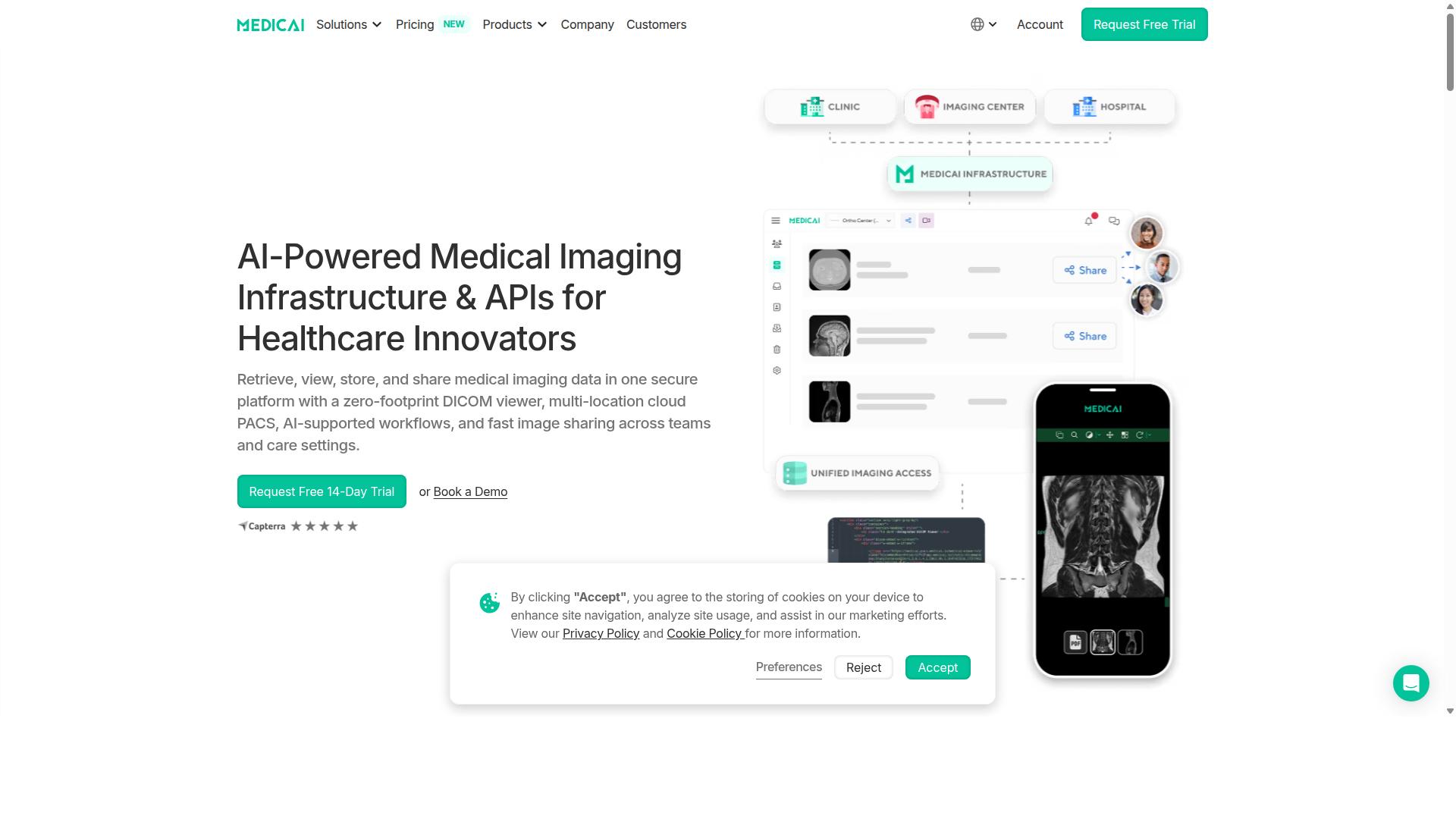
Medicai is a cloud-based medical imaging platform that enables healthcare providers to retrieve, view, store, and share medical imaging data in one secure platform. The system centers on a zero-footprint DICOM viewer that requires no local software installation.
This single-platform approach handles multiple imaging needs through one interface. Healthcare teams can access studies from different locations without switching between separate tools or systems.
Imaging Infrastructure as a Service forms the foundation of Medicai operations. The platform supports multi-location cloud PACS and AI-supported workflows that connect teams across various care settings.
Fast image sharing keeps pace with clinical demands. Specialists in different departments can review the same study simultaneously without file transfers or format conversions.
The platform focuses on modernizing medical imaging workflows and enabling interoperability between healthcare systems. VC-backed development supports continuous improvements to the core infrastructure.
Why Medicai Is the Best for Highly Scalable Systems
The platform demonstrates scalability through 1M+ studies processed annually, 1.7M+ studies in storage, and 50M+ yearly API transactions while maintaining HIPAA/GDPR compliance. Elastic scaling allows resources to adjust automatically as demand increases. This approach prevents bottlenecks and supports growth without service interruption.
Multi-region deployment places data closer to users across different geographic areas. Distributed architecture keeps operations running even when individual regions face issues. Disaster recovery infrastructure protects against data loss and maintains business continuity during unexpected events.
Horizontal scaling adds capacity by deploying additional instances rather than upgrading single servers. Container orchestration with Kubernetes manages these instances efficiently across the cloud environment. Resource allocation happens dynamically based on current workload requirements.
High availability comes from redundancy built into every layer of the system. Fault tolerance mechanisms detect failures quickly and redirect traffic to healthy components. Performance optimization ensures response times stay consistent even during peak usage periods.
Load balancing distributes incoming requests evenly across available servers. API gateway handles authentication and rate limiting while protecting backend services. Caching layers reduce database load and speed up frequently accessed information.
Database optimization techniques like data sharding split large datasets across multiple storage nodes. NoSQL and SQL databases work together depending on specific data access patterns. This combination maintains data consistency while supporting high throughput operations.
Observability tools provide real-time metrics, logging, and alerting for system health monitoring. Infrastructure as code enables consistent deployment across environments. CI/CD pipeline automation accelerates the release of performance improvements and security updates.
Edge computing processes data closer to the source rather than routing everything through central servers. CDN delivery speeds up content distribution for users in different locations. These strategies reduce latency and improve overall system responsiveness.
Replication keeps copies of critical data synchronized across multiple locations. Backup procedures run regularly to prevent permanent data loss. Redundancy at every level ensures the platform can handle millions of studies as demand grows beyond current volumes.
Key Features and What Makes Medicai Stand Out
Three core capabilities differentiate Medicai in the medical imaging market. The platform combines cloud infrastructure, multi-location connectivity, and workflow automation to support growing healthcare organizations. These features work together to handle increasing volumes of medical imaging data without performance degradation. Organizations can expand their imaging services while maintaining consistent access and security standards across all locations.
Cloud PACS and Vendor Neutral Archive
The Cloud PACS and Vendor Neutral Archive architecture enables secure medical image storage with built-in redundancy. This system stores imaging data across distributed cloud environments that scale automatically as new studies arrive. Backup and Disaster Recovery protocols protect against data loss through multiple replication layers.
Vendor-neutral storage standards allow facilities to maintain data independence from specific equipment manufacturers. The platform supports both SQL and NoSQL database optimization to handle different types of imaging metadata efficiently. High availability comes from multi-region deployment that keeps images accessible even during regional outages.
Elastic scaling adjusts storage and processing resources based on current demand patterns. This approach eliminates the need for manual capacity planning as imaging volumes grow. Organizations benefit from performance optimization that maintains consistent response times regardless of data volume increases.
Multi-Location Image Exchange
The Medical Image Exchange system connects imaging centers and hospitals across geographic locations. DICOM Gateway and Medical Imaging Uploader tools enable secure transfer between facilities without compromising data integrity. These components create a network that supports real-time collaboration between remote medical teams.
The platform handles data sharding across multiple storage locations to optimize transfer speeds. Each facility maintains local access while participating in the larger network exchange. Fault tolerance ensures that image sharing continues even when individual locations experience connectivity issues.
API gateway functionality allows integration with existing hospital systems at each location. This connectivity supports consistent workflows across distributed healthcare networks. Organizations can add new facilities to the exchange without disrupting established data sharing processes.
AI-Supported Workflows
AI integration accelerates image analysis while maintaining diagnostic quality standards. The platform incorporates Rayscape.ai for automated image analysis and workflow optimization. These tools identify patterns in medical images that support radiologist decision-making processes.
AI-Powered Diagnostics reduce the time spent reviewing routine cases while flagging studies that require additional attention. The system processes images through multiple analysis layers before presentation to medical staff. Performance optimization ensures that AI processing does not create delays in clinical workflows.
Container orchestration manages AI model deployment across the cloud infrastructure. This approach allows for horizontal scaling as AI processing demands increase. Organizations can expand their use of AI tools without requiring additional technical infrastructure or specialized maintenance staff.
Pricing and Plans
Two subscription tiers provide flexibility for organizations of different sizes. The Starter plan costs $249 per month and includes 500 GB of cloud storage with unlimited user accounts but no connected locations.
The Standard plan costs $749 per month and provides 2 TB of cloud storage with unlimited user accounts plus one connected location. This tier suits growing organizations that require basic connectivity between facilities.
Both plans support the scalability needs of healthcare providers through cloud-native infrastructure. Organizations can upgrade between tiers as patient volume and storage requirements increase over time.
Yearly billing provides 15 percent savings, with the Starter plan at $209 per month and the Standard plan at $639 per month. A 14-day trial of Starter plan features allows teams to evaluate performance before committing to a subscription.
Enterprise customers can access custom pricing that includes multiple connected locations and external connections. Per-study pricing options are also available for organizations with variable imaging volumes.
The DICOM Gateway setup fee of $1,000 applies per location for organizations that need direct imaging equipment connectivity. This one-time investment supports elastic scaling as facilities expand their digital infrastructure.
Trust Signals
Compliance certifications and usage statistics demonstrate platform reliability. Healthcare organizations require verified security standards before adopting medical imaging solutions at scale. Medicai meets these requirements through established regulatory clearances.
The platform maintains HIPAA and GDPR compliance to protect patient data across regions. These certifications ensure that medical imaging workflows meet strict privacy requirements regardless of deployment size. Organizations handling sensitive health information can trust the platform with their operational needs.
FDA and CEE cleared viewers provide additional validation for clinical use. Medical institutions need assurance that diagnostic tools meet regulatory standards for patient care. These clearances confirm that the platform supports clinical decision making at enterprise volumes.
Processing over 1M studies annually shows consistent performance under real world demands. The system handles 50M API transactions yearly while maintaining 1.7M studies in active storage. This volume demonstrates the infrastructure can support large scale healthcare networks.
OWASP security guidelines provide additional protection layers for medical data. The platform follows established security practices that address common vulnerabilities in healthcare applications. This approach reduces risk for organizations managing distributed medical imaging operations.
Who Should Use Medicai
Hospitals, imaging centers, and specialty care providers across multiple medical disciplines benefit from the platform. Organizations that manage high imaging volumes or coordinate care across departments find scalable infrastructure essential for reliable service delivery.
Orthopedics practices rely on consistent access to imaging studies and patient records. The platform supports this need through distributed architecture and fault tolerance features.
Neurology and oncology departments handle complex cases that require frequent collaboration. Elastic scaling and load balancing help maintain performance during peak demand periods.
Radiology and cardiology services process large volumes of diagnostic images daily. Cloud-native design and horizontal scaling allow these departments to grow capacity as needed.
Ophthalmology, ob-gyn, and pulmonology clinics often need flexible scheduling and remote access. High availability ensures these practices can serve patients across different locations.
Dentistry and gastroenterology groups benefit from streamlined workflows and reliable data management. Microservices architecture and container orchestration provide the technical foundation that supports these varied medical needs.
Virtual care providers and telemedicine platforms also use the system. Teleradiology services and tumor boards find the platform accommodates their specific collaboration requirements through API gateway capabilities.
Personal injury lawyers, clinical trial coordinators, and medical education organizations access the platform for specialized document and image handling. The Patient Portal extends these capabilities directly to patients who need secure access to their medical information.
Final Verdict
Medicai provides healthcare organizations with scalable, compliant medical imaging infrastructure. The platform supports growing data volumes and user bases without compromising performance or regulatory requirements.
Organizations that need robust medical imaging systems benefit from a cloud-native architecture designed for horizontal scaling. This approach lets teams expand capacity as demand increases rather than replacing entire systems.
Implementation discussions can start by reaching out to the proper regional office. Medicai USA operates at 7901 4th St N, STE 300, St. Petersburg, FL, 33702 and can be reached at +1 (832) 220 1035.
European healthcare providers can contact Medicai Romania at 53-55 N Filipescu, 5th Floor, Sector 2, Bucharest, 020961 or call +40 316 305 875. Email inquiries are handled directly at [email protected].
The platform's distributed architecture and elastic scaling capabilities make it suitable for institutions that require high availability and fault tolerance. Healthcare organizations can discuss their specific scalability requirements with the sales team to explore implementation options.
Recommended Resources: