Who's the Best for Cloud PACS: Studycast vs Medicai
Radiology departments now juggle imaging from multiple clinics and still need fast, compliant sharing across care teams. Hospitals using older PACS often face storage caps and slow access for remote specialists. This article compares Medicai and Studycast on storage, security, AI tools, and price so you can pick the platform that fits your workflow without later surprises.
By the end you will know exactly how each handles data volume, what security standards they meet, and which integrations each supports. You will also see side-by-side cost ranges and a clear recommendation on when Medicai or Studycast is the better fit for your practice.
Quick Verdict: Medicai Edges Out Studycast for Most Cloud PACS Needs
Medicai outperforms Studycast for healthcare organizations prioritizing scalable cloud storage and seamless multi-site access.
Storage capacity marks a clear difference between the two platforms. Medicai maintains 1.7M+ studies in storage with 1M+ studies processed per year. Most competitors in the cloud PACS space do not publish comparable volume metrics, which leaves organizations guessing about real-world capacity limits.
Viewer accessibility and integration depth provide another advantage. Medicai delivers a zero-footprint DICOM viewer alongside 50M+ yearly API transactions. General cloud PACS solutions often require additional software installs or limited API capabilities that restrict interoperability with existing hospital systems.
Security and reliability complete the comparison. Medicai holds HIPAA and GDPR compliance. Healthcare organizations evaluating cloud PACS options should verify these standards directly with any vendor under consideration, as compliance levels can vary significantly across providers.
At a glance: how Medicai compares to Studycast on the features that matter most.
| Feature | Medicai | Studycast |
|---|---|---|
| Cloud PACS | ✓ | ✓ |
What Is Medicai?
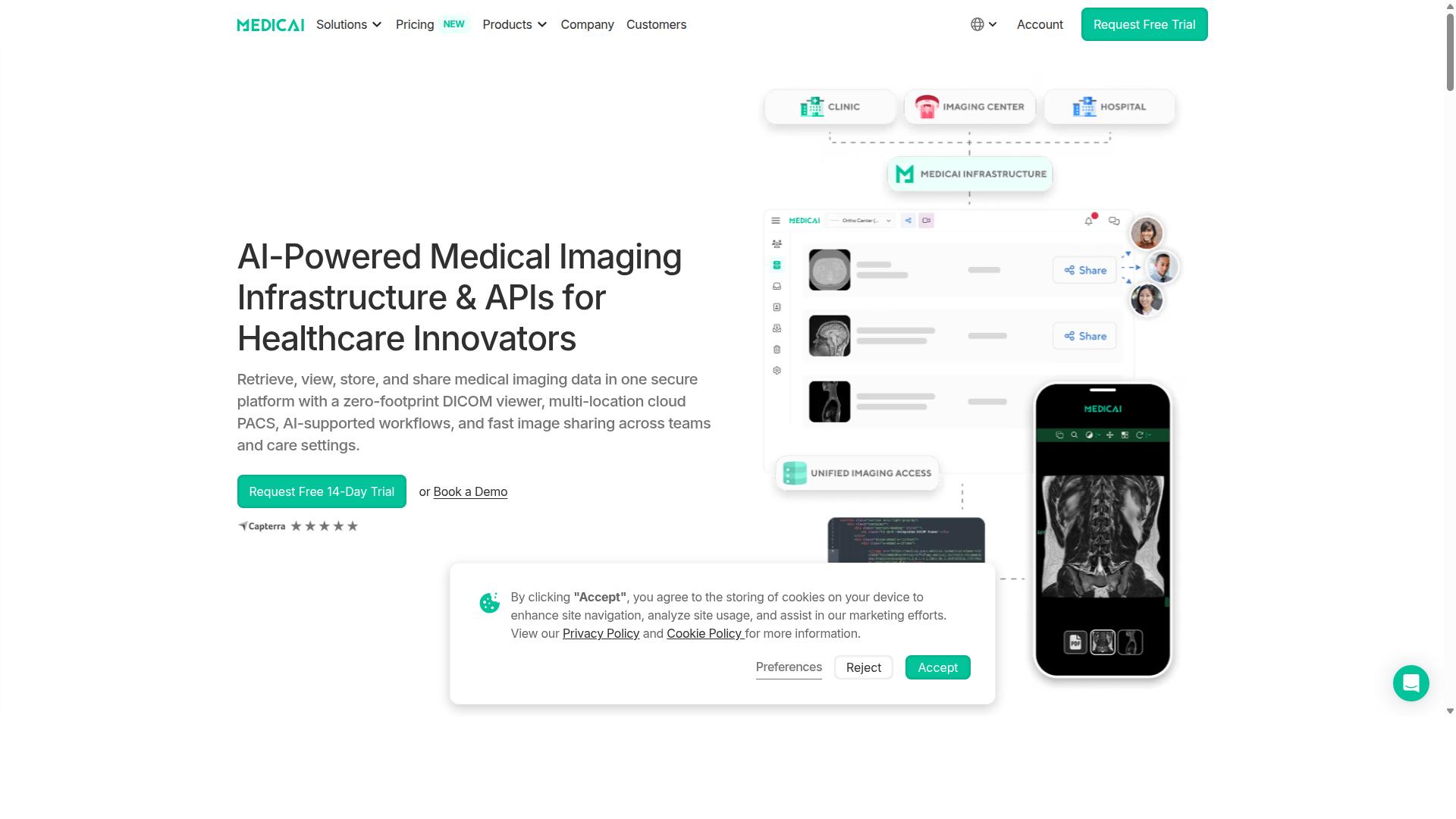
Medicai is a cloud-based medical imaging platform that enables healthcare providers to retrieve, view, store, and share medical imaging data in one secure environment.
The company operates from its headquarters at 7901 4th St N, STE 300, St. Petersburg, FL, 33702. This location serves as the base for its SaaS operations focused on modernizing medical imaging workflows.
Medicai provides a zero-footprint DICOM viewer that requires no local installation. Healthcare teams access the viewer from any web browser while maintaining full diagnostic capabilities.
The platform delivered over 300k DICOM visualizations last year. This volume demonstrates consistent performance across multiple healthcare settings and imaging modalities.
Medicai operates on a SaaS model that eliminates hardware maintenance requirements. Organizations pay subscription fees rather than investing in on-premise infrastructure that demands ongoing technical support.
The platform functions as Imaging Infrastructure as a Service (IIaaS). This approach supports medical imaging needs without requiring facilities to manage physical servers or storage systems.
Medicai serves as a cloud PACS solution built for interoperability. The system connects with existing healthcare IT environments while supporting workflows across multiple locations and care teams.
The company maintains VC backing as a healthcare startup. This funding supports continued development of features designed to address current challenges in radiology workflow and image management.
What Is Studycast?
Studycast is a cloud-based medical imaging workflow solution focused on diagnostic image management and physician collaboration.
Many healthcare organizations use cloud PACS platforms to store, view, and share medical imaging studies. Cloud storage allows radiologists and referring physicians to access studies from different locations without maintaining physical servers on site.
Users typically upload DICOM files through web browsers or integrated systems. The platform provides a diagnostic viewer that enables measurement, annotation, and report generation within the same interface.
Workflow features often include study routing, notification alerts, and multi-user access. These tools help radiology groups coordinate reads across locations and reduce the time between image acquisition and final report delivery.
Some platforms also offer integration options with existing electronic health record systems. Interoperability remains important when organizations need to connect imaging data with patient records and order entry systems.
Features Compared
Cloud PACS platforms differ in how they handle storage growth, security requirements, and external system connections. Medicai and Studycast each address these needs, yet their approaches vary in scope and transparency.
The following sections examine storage capacity, security posture, and third-party connectivity for both solutions. These factors influence platform selection for radiology departments and teleradiology practices.
Storage and Scale
Medicai Starter plan starts at 500 GB and scales to 2 TB on Standard, with unlimited user accounts and one connected location. Additional tiers offer custom storage volumes for multiple sites and external partners.
Global availability spans multiple regions with disaster recovery and backup redundancy built into each tier. Customers can add locations through a one-time DICOM Gateway setup fee per site.
Studycast provides storage and scaling options that follow typical industry patterns, though specific capacity limits and redundancy details are not publicly listed. Buyers often request detailed specifications during the evaluation process.
Security and Compliance
Medicai maintains HIPAA and GDPR compliance with SSL encryption, audit trails, and role-based access controls. Two-factor authentication and data residency options further strengthen its security posture.
OWASP security guidelines guide development practices. The platform supports FDA and CEE cleared viewers for diagnostic use.
Studycast maintains general compliance measures common to medical imaging platforms. Organizations typically request detailed documentation on encryption standards and access controls during procurement reviews.
Integrations and AI Support
Medicai offers 50M+ yearly API transactions and partnerships with MD.ai, OHIF, MedDream, and Rayscape.ai for AI-assisted workflows. The system supports HL7 and FHIR standards alongside Microsoft Azure and Amazon AWS infrastructure.
Additional connections include Tquila Automation, FlexView, Meditice, and Boehringer Ingelheim. These integrations enable radiology workflow automation and image sharing across multiple sites.
Studycast supports third-party connections at a general level, though specific API volumes and AI partnerships are not detailed in public materials. Detailed capability assessments usually occur during vendor demonstrations.
Pricing Compared
Medicai publishes transparent monthly fees, while Studycast pricing is not publicly detailed. This difference alone makes it easier for radiology practices to compare options and plan their budgets.
Medicai offers three clear tiers. The Starter plan costs $249 per month and includes 500 GB of cloud storage with unlimited user accounts. The Standard plan is $749 per month and provides 2 TB of storage with unlimited user accounts plus one connected location.
Yearly billing reduces costs further. The Starter plan drops to $209 per month when paid annually, and the Standard plan falls to $639 per month. These rates cover full Cloud PACS functionality without hidden fees for additional user seats.
Enterprise customers receive custom pricing. This tier supports custom cloud storage amounts, multiple connected locations, and external access points. Per-study pricing is also available for organizations that prefer transaction-based billing.
Additional costs include a one-time $1,000 DICOM Gateway Setup fee per location. A 14-day trial of the Starter plan gives teams time to test core features before committing to a subscription.
Who Should Choose Medicai
Hospitals, imaging centers, and specialty groups needing scalable storage and rapid image sharing should consider Medicai.
Departments handling high volumes of medical imaging benefit from Medicai's multi-site access capabilities. Radiology groups operating across multiple locations gain consistent viewing access without physical file transfers. This approach eliminates delays that occur when images must move between facilities.
Cardiology departments manage complex studies that require detailed review. Medicai supports these workflows through its diagnostic viewer designed for cardiac imaging.
Oncology teams coordinate treatment plans that depend on sequential imaging comparisons. Multi-site access allows oncologists at different locations to review the same studies simultaneously. This coordination supports tumor board meetings where specialists discuss patient cases across departments.
Orthopedic practices require precise measurements and annotations for surgical planning. The 300k+ visualizations indicate extended use across various medical specialties. This track record suggests the platform handles the specific demands of musculoskeletal imaging workflows.
Specialty care providers in neurology and ophthalmology also benefit from the same infrastructure. These departments often work with referring physicians who need remote access to studies. Multi-site capabilities allow secure sharing with external providers while maintaining HIPAA compliance standards.
Who Should Choose Studycast
Organizations with simpler workflow requirements may find Studycast adequate. This option may appeal to small imaging centers or single-site practices that need basic medical imaging storage and access without extensive customization.
Many facilities appreciate platforms that require minimal training and focus on core functions. Studycast may serve practices where radiologists work primarily within a single location and share studies through straightforward methods.
Some smaller teams prefer solutions that handle DICOM files and basic cloud storage without additional modules. These organizations often prioritize simplicity over advanced connectivity features.
Facilities that handle limited daily study volumes may find narrower feature sets sufficient for their needs. Staff members who prefer familiar interfaces rather than extensive configuration options may also gravitate toward this type of system.
Research suggests that practices with straightforward referral patterns and minimal multi-site requirements may find basic Cloud PACS solutions acceptable. The decision often depends on whether current workflows already meet operational demands without additional integration capabilities.
Final Verdict
For most healthcare providers, Medicai delivers broader storage, stronger compliance tooling, and transparent pricing.
With 1.7M+ studies stored and 50M+ API transactions completed, Medicai demonstrates proven capacity to handle large imaging volumes while maintaining reliability across multi-site networks.
Full HIPAA and GDPR compliance ensures data security meets regulatory standards in both the United States and European markets without requiring additional third-party security layers.
Organizations evaluating Cloud PACS options should consider their current study volume, compliance requirements, and integration needs before making a final decision.
Healthcare facilities seeking a free trial of Medicai can contact the company directly at Medicai USA, 7901 4th St N, STE 300, St. Petersburg, FL, 33702, or call +1 (832) 220 1035.